INTRODUCTION
If you're running a growing business and relying solely on a standard website, you may already be leaving money on the table. The distinction between a custom web app vs website isn't just technical jargon — it's a strategic decision that directly impacts how efficiently your business operates, how well you serve customers, and how fast you can scale.
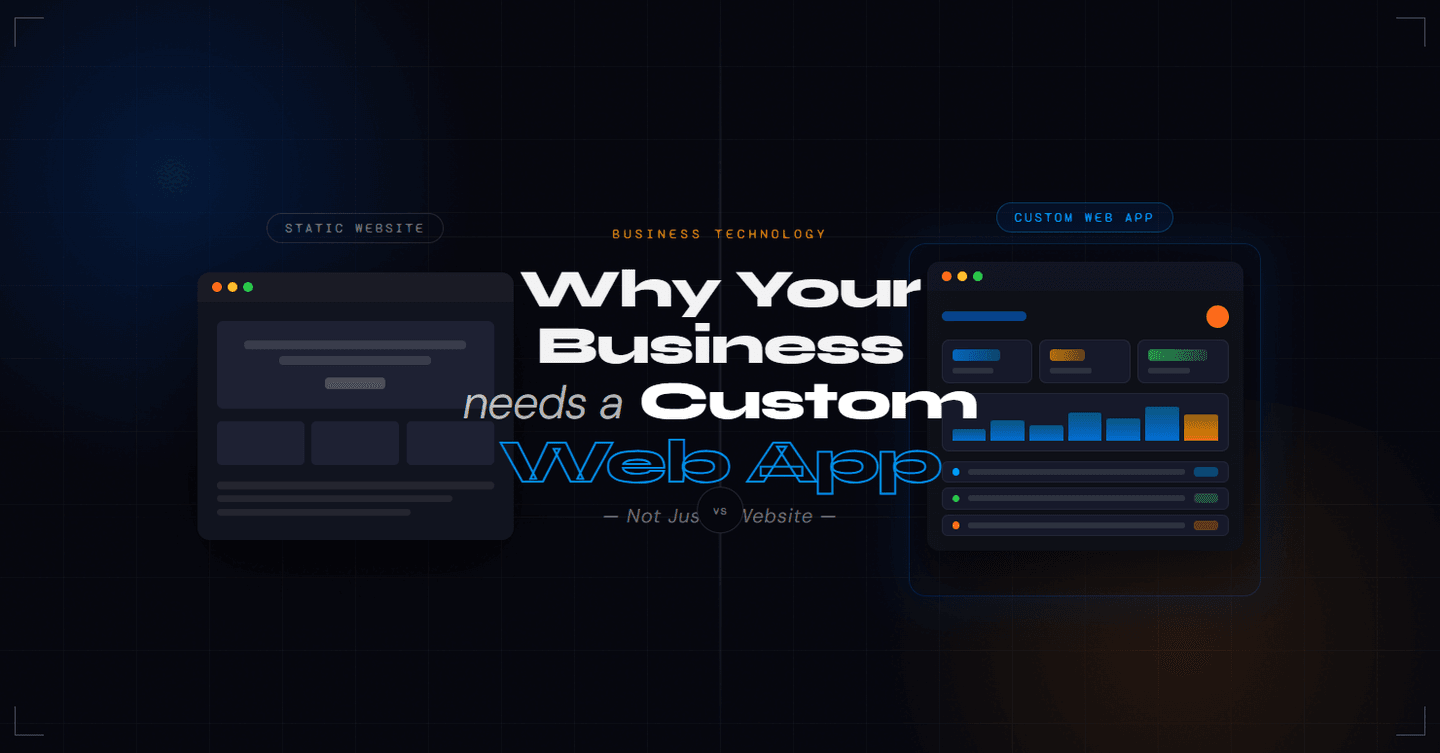
A website tells people who you are. A custom web app lets them do something — book, buy, submit, track, manage, collaborate. And for businesses with real operational complexity, that difference is everything.
In this post, we'll break down what separates the two, when you've outgrown a static website, and why a custom-built web application could be the single smartest investment your business makes this year.
WHAT'S THE ACTUAL DIFFERENCE?
A website is primarily informational. It presents content — your services, your story, your contact details — to visitors. Think of a brochure or a digital storefront window. A great website builds credibility and drives traffic.
A web app is interactive and functional. It's software that runs in a browser and lets users take actions: submit forms with complex logic, manage accounts, process payments, view personalized dashboards, trigger workflows, and more. Think of platforms like Shopify, Trello, or your bank's online portal — those are web apps.
The line blurs when a website gains features like a client login, a booking system, or an order tracker. That's exactly when most businesses realize: what they really need is a custom web app.
5 SIGNS YOUR BUSINESS HAS OUTGROWN A WEBSITE
1. You're managing critical workflows in spreadsheets or email threads.
If your team is coordinating orders, clients, inventory, or projects through a patchwork of spreadsheets and email threads, that's a clear sign a purpose-built web app could automate and centralize everything.
2. Your customers have to call or email to do things they should be able to do themselves.
Checking order status, updating account details, submitting documents, booking appointments — if these require manual intervention from your team, you're paying for inefficiency and your customers are experiencing friction.
3. You're duct-taping together too many third-party tools.
When you're relying on five different SaaS tools that don't talk to each other cleanly, you're paying recurring fees for fragmented solutions. A custom web app can consolidate these into a unified platform you actually own.
4. You're losing deals because competitors have better digital experiences.
Modern buyers expect seamless, personalized digital experiences. If your competitors offer a self-service portal and you don't, that gap is costing you.
5. You can't get the data or reporting you need.
Off-the-shelf tools give you their analytics. A custom web app gives you yours — built around the KPIs and workflows that actually matter to your business.
WHY "JUST USE A WEBSITE BUILDER" DOESN'T SCALE
Website builders like Wix, Squarespace, and even WordPress with plugins are genuinely excellent for what they're designed to do. They get you online fast, look professional, and work well for content-driven businesses.
But they're built for the general case. Your business isn't general.
When you need custom logic — multi-step workflows, role-based access controls, real-time data, integrations with your CRM or ERP, or anything that doesn't fit neatly into a plugin's checkbox — you hit a wall. You end up hacking together workarounds, paying for plugins that almost do what you need, and still maintaining manual processes alongside the tool.
Custom web apps are built around your exact requirements. There's no "almost" — the software does precisely what your operation demands, and it grows as you do.
THE BUSINESS CASE: ROI OF A CUSTOM WEB APP
The upfront investment in a custom web app is higher than spinning up a website. That's true. But the return profile is fundamentally different.
Consider what you gain:
- Operational efficiency: Automating a manual process that takes a team member 2 hours per day saves roughly 500 hours per year. At any reasonable labor cost, the math pays for itself quickly.
- Customer retention: A smoother, more capable digital experience directly reduces churn. Customers who can self-serve are more satisfied and less likely to leave.
- Scalability without proportional cost growth: A well-architected web app can handle 10x the users without 10x the staff. That's leverage.
- Ownership: You're not renting software. You own the asset, and it appreciates as you improve it.
- Competitive moat: A custom-built system that's tailored to your workflows and customer experience is genuinely difficult for competitors to replicate.
WHAT MAKES A WEB APP "CUSTOM"?
Custom doesn't just mean it looks unique. It means it's engineered specifically for your:
- Business logic (your rules, not a vendor's defaults)
- User roles and permissions
- Data model and reporting needs
- Integration requirements (your payment provider, your logistics system, your internal tools)
- Performance and scalability targets
- Brand and UX standards
When we build web apps for clients, the process starts with deeply understanding how the business actually operates — then designing and building software that reflects and accelerates that operation, rather than forcing the business to conform to an off-the-shelf tool's limitations.
IS A CUSTOM WEB APP RIGHT FOR YOU?
Not every business needs one right now — and we'll be honest about that. A simple informational website with contact forms genuinely serves some businesses well for years.
But if any of these are true, it's worth a conversation:
- You process a significant volume of orders, clients, or transactions that require tracking and management.
- Your team spends meaningful time on tasks that could be automated.
- You have compliance, security, or data requirements that generic tools can't satisfy.
- You're scaling and need infrastructure that grows with you.
- You've already hit the ceiling of what website plugins and SaaS tools can do for you.
CONCLUSION
The question isn't really "website vs web app" — it's "what does my business actually need to operate and compete at the level I'm aiming for?"
For a lot of growing SMBs, the answer is clear: a custom web app isn't a luxury. It's the foundation for the next stage of growth.
We specialize in building custom web applications that are fast, scalable, and built around how your business works — not the other way around. From initial scoping to post-launch support, we handle the full lifecycle so you can focus on running your company.